Accidental entrepreneur
While many are going bust, business is booming for Erin Kelly-Dill of Plainfield -- making sandwich bags
Friday, June 5, 20091

2

3

5

Erin Kelly-Dill of Plainfield recalls feeling guilty -- and frustrated -- five years ago as she packed lunches for her two oldest children to take to school.
"I kept thinking to myself," she recalls, "'There's got to be another way to do this,'" as she'd fill little plastic disposable bags with food. "And I felt terrible, thinking of all the trash I was helping to generate, all these sandwich and snack bags ending up dumped in a landfill."
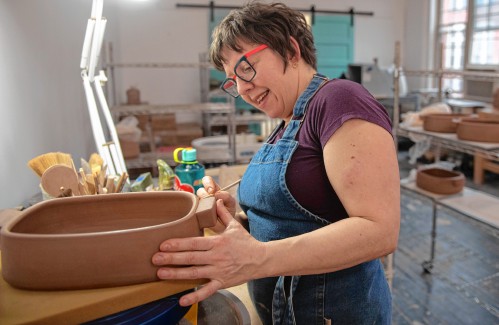
These days, Kelly-Dill is generating something else -- lots of sales of the product she devised to come to grips with the Ziploc bag menace. She's coupled her longtime love of sewing with an environmental ethos to create a deceptively simple item that has begun to catch on with the public in a big way. What she calls the "snackTAXI" -- a washable, reusable bag that's just large enough for a sandwich or a large snack -- is now selling briskly in stores across the country and over the Internet.
That's thanks in part to enviable media coverage, including a feature on CNN and a plug on the Oprah Winfrey show in April, which sent orders through the roof.
It's not what Kelly-Dill expected when she began making the bags, first for her family, then for friends, some local customers and a few area stores. Now she has several employees in her home,located on an unpaved, forested road, working feverishly to keep up with orders.
As Kelly-Dill sees it, suddenly wrestling with more work than she can handle is not really a problem in light of the struggles many businesses are facing these days. "It's what you fantasize about when you have a business," she says. "And I like it that it's right here in my house and that the people who work here live around here -- I like to think I'm supporting the local economy." How local? Consider that one of her sewers, Arleen Snape, who lives in Chesterfield, knew Kelly-Dill when she was growing up in Plainfield.
Yet the big surge in business has taken her by surprise and made for long working hours morning through mid-afternoon, then again late into the night after her children -- Finnian, 12, Dory, 10, and Eolann, 8 -- have gone to bed. "I still have a family I need to spend time with," she says. "We have to bring the kids to and from school, and to their activities, and my husband works long hours at his own job."
Her husband, Kevin McMillan, is the director of guided programs at Zoar Outdoor in Charlemont. When he can, he helps his wife with the processing of Web orders and other paperwork that can keep her up to 2 or 3 a.m.
Kelly-Dill also misses the time she used to spend doing yoga or jogging with her husband; right now her main exercise comes from carrying crates of mailing packages into Plainfield's tiny post office. But she's happy to ride the wave -- thankful there's money coming in after some lean years, and glad to be offering a product that provides environmental benefit.
It's a strange situation she finds herself in, she adds, "but it's not a bad one. It's actually pretty good -- in a way."
*****
One morning in mid-May, four women are bent over sewing machines in a sunny space that was once Kelly-Dill's dining room. Behind the workers -- Emmy Howard, Theresa Torrey and sisters Denise Sessions and Arleen Snape -- is a series of shelves filled with stacks of cotton fabric in a wide range of colors and patterns. Slews of order forms are tacked on a wall, like food orders in the kitchen of a fast-paced restaurant.
The snackTAXIs are slender, washable cotton pouches with nylon interiors. A flap with a Velcro fastener closes them up. They come in two sizes -- 6 by 4.5 inches and 7.5 by 6 inches -- and sell for $6.95 and $8.95, respectively, and can be ordered at the Web site www.snacktaxi.com.
Kelly-Dill also sells conventional canvas lunch sacks which are made for her by another small company.
Barefoot and wearing jeans and a thin, zippered sweatshirt, Kelly-Dill jokingly tells Snape, who is sewing fasteners onto the bags, to pick up the pace.
"C'mon, Arleen," she says, trying to sound stern but breaking out in laughter. "Get cracking!"
"I'm trying, I'm trying!" responds Snape in mock horror. "I'm going as fast as I can."
The other sewers laugh as well.
The work environment at the house is a good one, says Emmy Howard of Plainfield, who adds that she's grateful for the work. But there is a real sense of intensity these days as orders pile up. Kelly-Dill, who still does some sewing herself when she's not processing orders or reading and answering email, says they're making and shipping several hundred of the bags per week.
"We're still behind, and will be for a while," she says. "It took us the last three weeks to complete three days' worth of orders." Fortunately, she adds, "The kind of people who buy snackTAXIs are a nice crowd -- they're pretty understanding about the delays." The company's Web site, since late April, has warned customers about the delays -- currently about four weeks -- which became a real problem after what Kelly-Dill refers to as the "15 seconds of fame" her company received on the Oprah Winfrey show.
She now employs two of her sewers at 40 hours a week and two others at 32 hours a week; a fifth local woman works about 15 hours from her own home. There's also a part-time administrative assistant/bookkeeper, and Kelly-Dill is hoping to hire her full time as an administrative assistant and find another part-time bookkeeper. She pays another person for designing and maintaining her Web site. Her husband, in addition to helping with paperwork, cuts the big sheets of cotton fabric and nylon that are delivered to the house, breaking them down into the sizes needed for the snackTAXIs.
Kelly-Dill is reluctant to give sales figures, but adds, "Quite honestly, I really don't know exactly what we're making right now, just because we've been so caught up in the day-to-day stuff." She says the first year she pursued the business seriously -- 2007 -- she cleared about $4,000. Since then, sales have definitely "exploded," she says.
The business, which Kelly-Dill ran entirely by herself at first, began to pick up steam last summer after the Disney magazine Family Fun, based in Northampton, did a story after staffers spotted the snackTAXIs in downtown stores. Following that came a segment on Channel 40 News in Springfield and then one on CNN, and consequently more orders. By then, Kelly-Dill had three people working for her.
Then, following a busy Christmas season, members of Winfrey's staff -- some of whom used the product themselves, Kelly-Dill says -- selected the snackTAXIs to be featured with other "green" products on the show's Earth Day episode on April 22. Kelly-Dill had to send a batch via over-night mail a few days before it aired. The morning after the program, over 350 orders arrived via the Internet. Even higher numbers poured in during the next several days.
Seth Isman, economic development director for the Hilltown Community Development Corporation in Chesterfield, which aims to promote employment and business opportunities for area residents, has worked with Kelly-Dill over the past couple of years to help her expand her business. Recently, he says, he's coached her not to worry about it growing too fast; rather she should just concentrate on meeting her orders.
"I spend a lot of time with clients who can't find enough customers or can't get the financing they need," says Isman. "It can be tough to run a business in the Hilltowns, especially in this economic climate." Kelly-Dill's situation, by contrast? "I love to see this," he says. "She's really caught the reusable, green product wave, plus she's simply a good designer -- she makes an attractive product."
"I call Seth a lot," adds Kelly-Dill. "He's like my business therapist."
*****
At 39, Kelly-Dill has had a slew of jobs -- waitress, reporter, sewing teacher, baker -- and has also worked in clothing retail. Growing up in Plainfield, she attended Sanderson Academy in Ashfield for her early years in school, then went to the Williston Northampton School in Easthampton for high school. She later graduated from the University of Massachusetts at Amherst with a degree in art history.
She did some traveling in her early 20s with her husband, who's originally from England, after which the couple settled down in her hometown. At that point Kelly-Dill, who had taken up sewing as a teenager, started her first business, making a small line of clothing for babies and young children -- hats, reversible jackets and pants, bathrobes -- that she sold mostly at craft fairs. She also sewed for VOmax, a manufacturer of custom cycling and ski clothing that was once located in Plainfield and is now in Northampton.
"I was always trying to find something I really enjoyed doing that maybe I could make a little money at," she says.
And then her frustration with the plastic bags in her kids' lunches prompted a visit to The Creamery in Cummington for a presentation on how the general store was trying to reduce its impact on the environment. Impressed by the talk, she looked for ways to make improvements in her own home, and out of that came the prototype of the snackTAXI, which she then called a "Happy Sack" (copyright issues prompted the name change).
She started out making the snack bags just for her own children, but counselors at a day camp one of them attended asked if she could make some for them. That set Kelly-Dill to thinking: "I thought I should see who else might be interested." So she took samples to The Creamery and the Ashfield Hardware & Supply store, which took them on. "I built up a good local base -- I was probably making a dozen or so a week," Kelly-Dill says.
Still, she wasn't sure how seriously she wanted to pursue the fledgling business. With all her children now enrolled in the Hilltown Cooperative Charter Public School in Haydenville, she took some nursing classes at Greenfield Community College, thinking she might want to pursue that as a career. In the end, though, she decided she really wasn't cut out for nursing; in fall 2007 she began trying to sell her bags to a wider market.
With guidance from Seth Isman at the Hilltown CDC, she researched stores in Massachusetts and farther afield that might be interested, then sent samples with a brief description of the materials used, the motivation behind the product, and the pricing.
Over 50 percent of the stores asked to stock the snackTAXIs, she says: "Apparently that's quite good, more than typical."
She also refined her technique for making the snack bags, starting with the materials. She'd been traveling to a fabric warehouse south of Boston to buy rolls of cotton, which she'd pile in her car for the long drive home. "It wasn't the most efficient way to do it," she says. Instead, she picked out the fabrics she liked best and contacted the manufacturers, who now ship them to her home at wholesale prices.
The bulk of the cotton she buys, she says, as well as all the nylon used for the snackTAXI interior, has been tested to ensure it's free of toxics such as lead, phthalates and heavy metals. "It didn't seem right to be selling a product with a kind of environmental theme if it used unsafe materials," she says. Ideally, she'd use organic cotton for the outer lining, but she says the cost -- about five times that of conventional cotton -- would make the snackTAXIs too expensive.
"I get it, that organic cotton is better for the environment," she says. "But I want to make something that people can afford."
By spring 2008 she had placed snackTAXIs in about two dozen stores, and she had hired Denise Sessions -- a Plainfield librarian who had worked with Kelly-Dill as a sewer at VOmax -- to help her fill her slowly increasing orders.
But now, that's all changed.
After the publicity they've generated, the snackTAXIs are sold in dozens of stores (including several in the Valley) in 24 states, as well as a few in Canada, and Kelly-Dill says she's had to turn down requests from other stores and independent sales representatives for the moment, as she and her employees crank through the backlogged orders.
"Everything's happened so fast," she says. "I hadn't made a business plan, and then there's this sudden increase and you don't have a choice ... I have to deal with things as they come up. I can only react to them."
"She's really in a fortunate position right now," says Isman. "She can choose her customers."
Still, viewing herself as a business owner doesn't come naturally to Kelly-Dill, who has chickens roaming in her front yard. "I think part of it's just being in a little community like Plainfield," she says. "Living out in the middle of the woods, I feel you lose track of how big the world actually is. All it takes is 500 Internet orders from people all over the place to make you remember just how many people there are."
She was reminded of that last December, when the fierce ice storm that swept through the area knocked out power to her house for eight days, and Internet and phone service for over two weeks (the family still had their gas heat). "It was a nightmare -- it happened just as the CNN story had come out," she says. She ran the sewing machines on generators, but had to drive down to her mother's house in Williamsburg to use the computer and phone there. "It really slowed us down."
The home business/big world contrast also pops up whenever she takes her crates full of shipping packages to the Plainfield post office, located in a tiny addition to an old clapboard house, with a sagging wooden porch that's stacked with firewood. At first, Kelly-Dill was nervous about bringing all her packages there, fearing she might overwhelm the place, but in fact the employees have welcomed the business, even donating the crates to her.
"It's great to see somebody having success like this, someone right in our town," says Susan Nye, the Plainfield postmaster. "I know it's exciting for Erin and her family. And it's fine to have the extra business -- we welcome it."
For her part, Kelly-Dill is adamant about keeping her business in town and relying on a local workforce. "I don't want to outsource anything," she says. She's now providing vacation time and personal days for her two full-time employees and is looking to do the same, on a prorated basis, for parttimers.
She's taken a preliminary look at moving the business to another building in town but says she really wants to keep it in her home. Doing so might require adding onto the house or building another structure on her property, she notes, but any such moves are still well down the road.
Isman says Kelly-Dill would likely find it easier to deal with the growth of her business by contracting out a chunk of the work, or relocating the main operation to a bigger town, where there would be a larger pool of employees. "But she's made it clear that's not what she wants to do," he says. "She still insists on inspecting every bag that's made and keeping the work local, and it's my job to follow [business owners] where they want to go."
Besides, he says with a bit of a chuckle, "Erin thrives on chaos. She wouldn't be that comfortable if everything was just smoothly humming along."
So what happens if a certain percentage of her stores get frustrated if she can't keep up with their orders? Does she simply get bigger, perhaps making some concessions in how she operates, or does she accept the potential loss of business if she doesn't?
"I don't know," she says, with a look that's half-bemused, half-frazzled. "I don't know. I'll guess we'll have to see what happens. What else can I do?"
Steve Pfarrer can be reached at spfarrer@gazettenet.com.


Comments
Post new comment